
I spent the past few days in London, where I spent the first two evenings by myself but not wanting to completely lose my mind, I decided to have some companionship for the remaining three evenings in the city. You will find below a faithful account of my three London companions:
Alfred Hitchcock’s Rear Window:
A quick Google search showed that the Prince Charles Cinema was showing some interesting films and the tickets were not particularly expensive. Between Wong Kar Wai’s In The Mood for Love, a film I have watched many times, and sold out tickets to Apocalypse Now, I settled on Hitchcock’s 1954 murder mystery Rear Window. I felt a lot of sympathy for the protagonist, the poor journalist whose broken leg confined him to his apartment, leaving him with no other entertainment than watching people from his window (who isn’t guilty of watching others?). One evening, between sleep and wakefulness, he believes he witnessed a murder. Maybe he did. I will leave you to find it out on your own. For now, I am mostly interested in learning how Grace Kelly did her hair.
François Ozon’s L’Étranger:
Now the irony is not lost on me that I decided to watch a French film in London but life is absurd with no meaning whatsoever, as Camus likes to remind his readers, so why not watch a French film in London while drinking a Japanese yuzu beer? Why not watch Meursault, in black and white, commit a mindless murder … everything is pointless, the murder, the past, the future, especially the present, the city of London, Paris, New Delhi, Calcutta, Camus, Maria Casares, the governments, the trains, the money exchanger at St Pancras, the idea of time passing, and who can think of a more absurd thing than the Oyster Card and fish & chips with mushy peas?
Agatha Christie’s The Mousetrap:
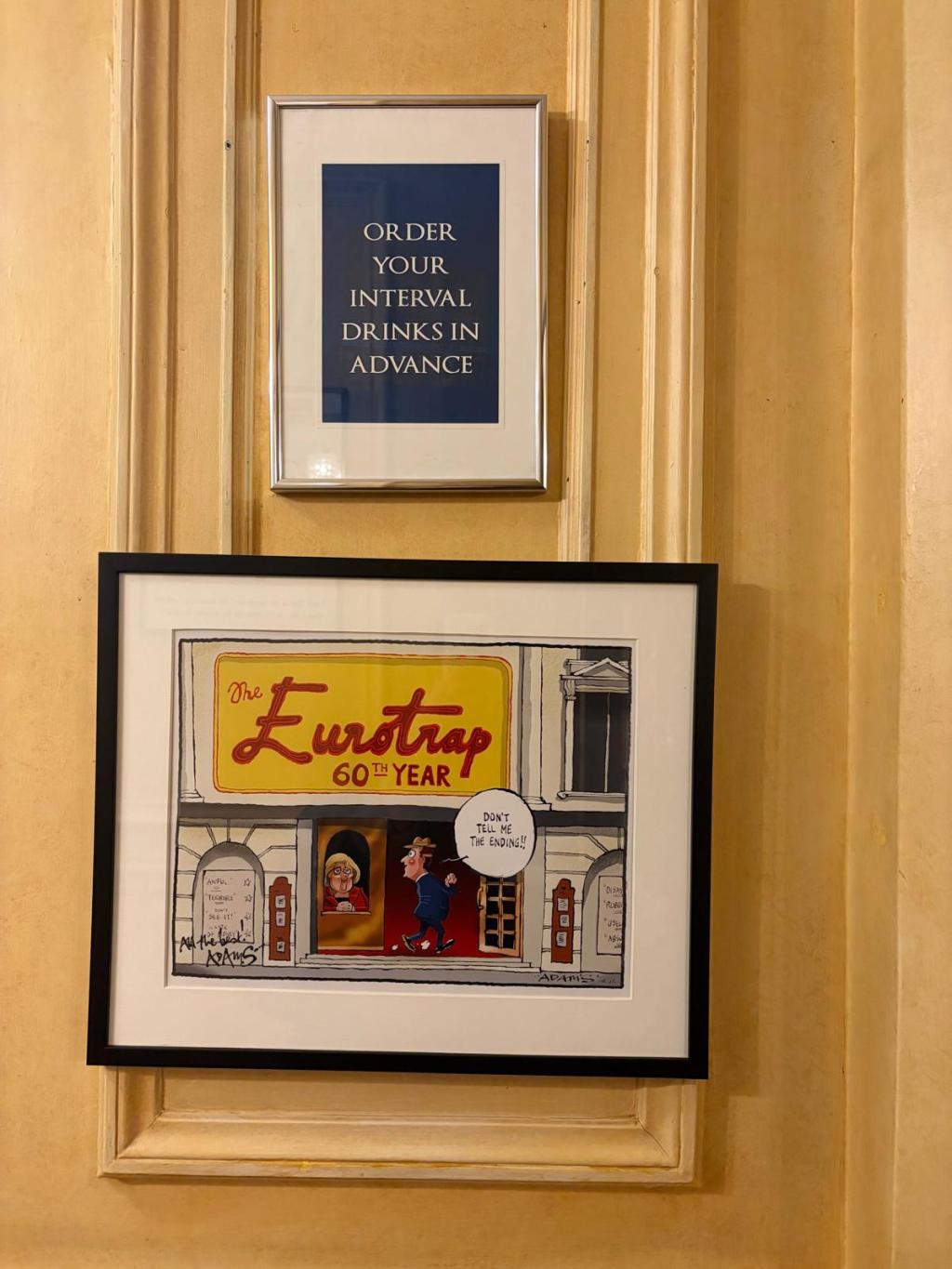
On my mother’s gentle prodding (though when is my mother ever *gentle*?), I booked a (grave cher, as Parisians would say) ticket to the longest running West End show about a newly opened inn and a murder that takes place inside it. I have nothing really to say about the play because I am bound by the promise of secrecy the audience made to the actors except that I saw my future in the grumpy old woman unhappy with her lodgings, the state of affairs (how can I not agree when she insists that every hotel should have a proper staff?) and everything else around her. Maybe it’s the British influence on the Indian mind.
It was not consciously that I ended up choosing murder across all three evenings and I hadn’t even realised it until I began to write this. Perhaps it says something about the state of my mind or perhaps it says something about London but it’s better not to find out.

