
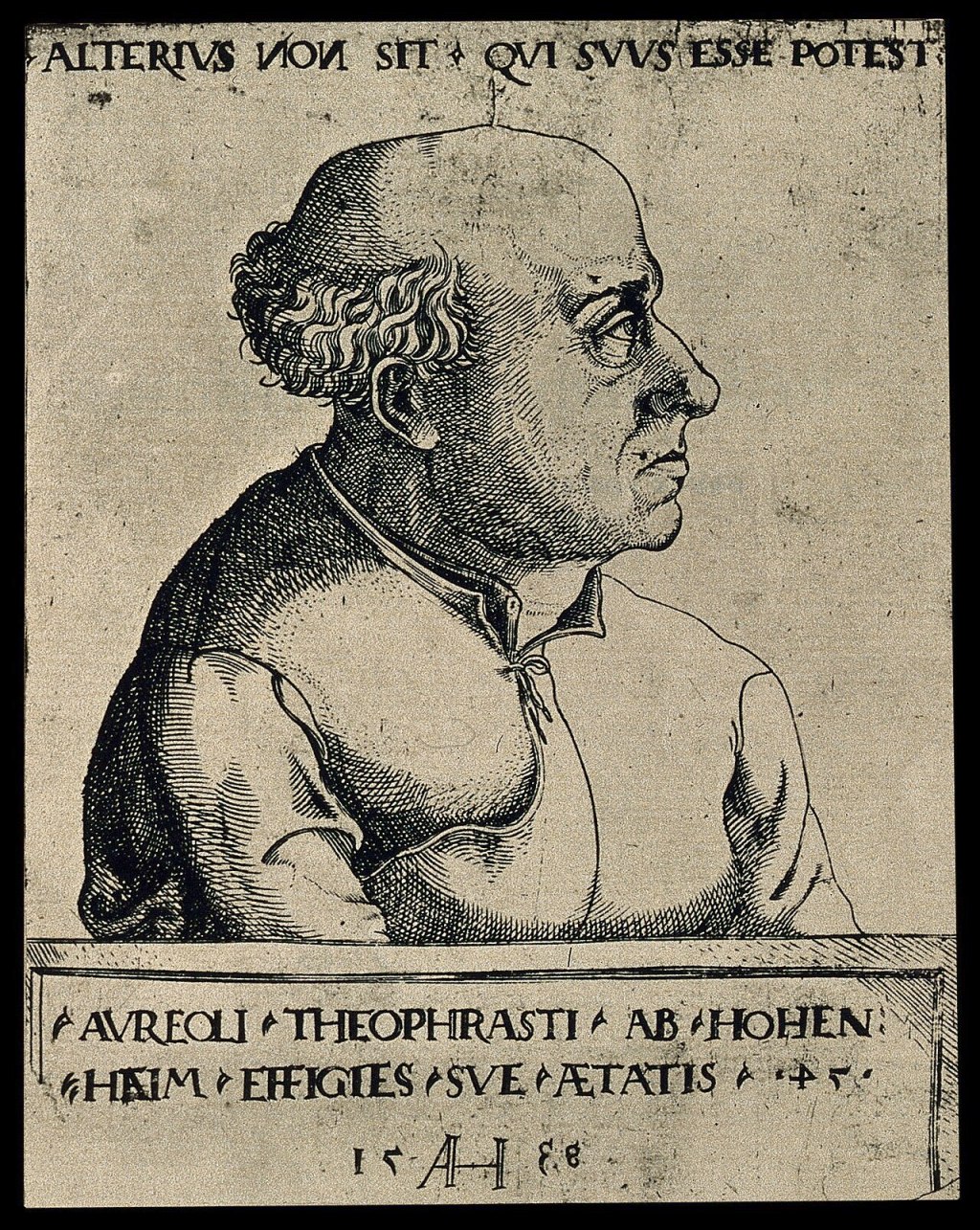
Paracelsus wrote in 1538, “Alle Dinge sind Gift, und nichts ist ohne Gift; allein die Dosis macht, dass ein Ding kein Gift ist,” or all things are poison, and nothing is without poison; the dosage alone makes it so a thing is not a poison.
Born Philippus Aureolus Theophrastus Bombastus von Hohenheim in Einsiedeln, Switzerland, Paracelsus, considered the somewhat forgotten progenitor of modern toxicology and credited with introducing chemistry to medicine, gave himself the name of Paracelsus, meaning beyond Celsus, a Roman writer of the 1st century AD who compiled a large encyclopaedia of which only the medical section, De Medicina, survives. During his early years, Paracelsus travelled extensively across Europe serving as an army surgeon, though he had to flee Salzburg to avoid arrest for his involvement in the Peasants’ Revolt, eventually settling in Strasbourg before being called to Basel to treat the prominent printer Johann Froben, whom he apparently cured. This brought him to the attention of Erasmus, who wrote to him in gratitude. In Basel from 1527, appointed city physician and university lecturer, he scandalized the academia by teaching in German rather than Latin, publicly burning the canonical texts of medieval medicine in the market square, and inviting barber-surgeons, alchemists, and apothecaries to attend his lectures alongside scholars. His friends remember him as a constant drunk and a glutton, not being able to stay away from alcohol for even an hour. His quarrelsome, undiplomatic nature made enemies wherever he settled, and Basel turned out to be no different. What followed was decades of wandering, moving through southern Germany, writing in bitterness and exile, developing his concept of medicine’s four pillars (natural philosophy, astronomy, alchemy, and virtue) while complaining that his mission had been misunderstood. In 1530, the authorities of Nuremberg banned the printing of his books.
In St. Gall he wrote another major medical work, observed Halley’s Comet and composed a theological treatise on its significance, and was pointedly ignored by the mayor to whom he had dedicated his efforts. He then came across the plague in Tyrol, consulted at a Swiss spa town, and finally published his surgical book in 1536, Chirurgia magna, one of the very few books printed in his lifetime. He completed his main philosophical work the following year, returned to his father’s homeland of Carinthia and was betrayed once more when officials who had promised to publish his final writings quietly backed down.
He died in Salzburg in 1541, at forty-seven, in a small room by unknown causes: either by mercury poisoning, accumulated after a lifetime of alchemical experiments, or by assassins hired by his enemies in the medical establishment. After his mysterious death, he acquired a bit of a reputation as a prophet, sometimes considered on Reddit threads as an alchemist who completed the great work.
I love Reddit threads like these, meandering through madness, though the Internet has become quite unbearable lately. I hear a lot about being a good person, online, offline, in metros, classes, on Instagram reels, emails, text messages from friends, Facebook ads. Everywhere I am, even where I am not, there is a discussion on goodness. In fact, sometimes it’s the only thing I see and hear about all day.
The other day, on my way back from the university, I was wondering if goodness can be measured, like mercury? At what dose does it become poison?

