
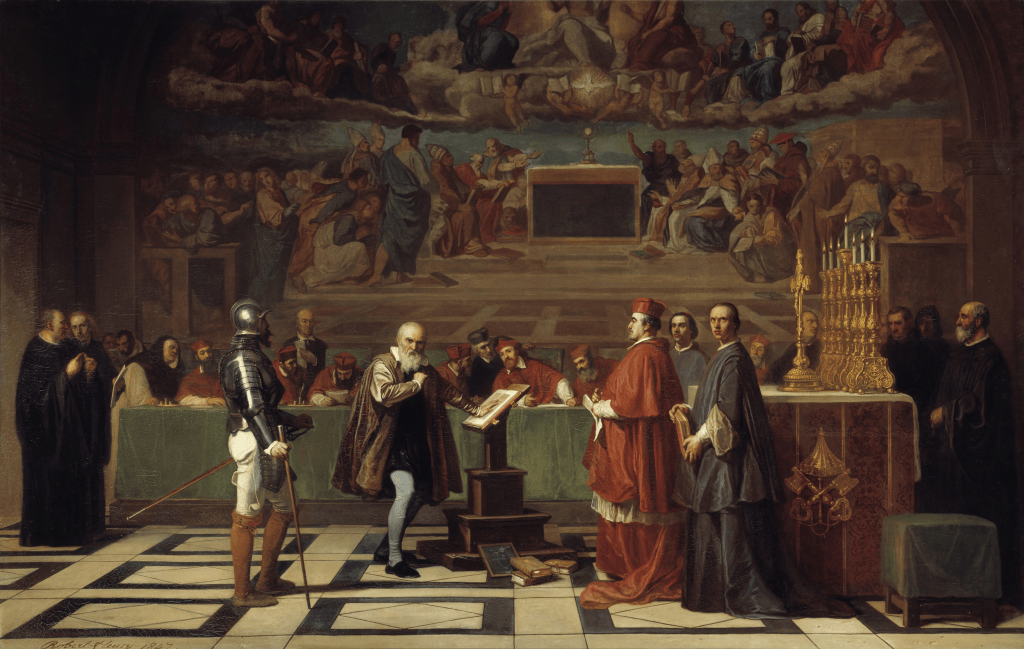
“Eppur si muove.”
(And yet it moves.)
(Apocryphal: What Galileo apparently said after torturers forced him to recant his theory that the earth orbits the sun)
It is perhaps not a coincidence that Galileo was named such, as the name derives from the late Latin Galilaeus (“of Galilee”), ultimately referring to the biblical region of Galilee, where Galileo’s ancestors originated from. Galileo Galilei (1564–1642) was an Italian astronomer, physicist, and mathematician born in the small town of Pisa, that holds the famous leaning tower, in the Duchy of Florence.
He first enrolled at the University of Pisa to study medicine but he soon shifted towards mathematics and natural philosophy, eventually teaching the subjects at Pisa and Padua.
Although he remained a devout Catholic, Galileo also had three illegitimate children with Marina Gamba outside of marriage: two daughters, Virginia (1600) and Livia (1601), and a son, Vincenzo (1606).
It was there that he conducted magnificent experiments on motion and mechanics and it was there that improved the telescope. His observations, published in Sidereus Nuncius (Starry Messenger, 1610), revealed the moons of Jupiter, the phases of Venus, and the rough surface of the Moon, giving strong scientific proof to the Copernican heliocentric system, that modelled Sun at the centre of the Universe, with Earth and the other planets orbiting around it in circular paths. The Copernican heliocentric system, developed by Nicolaus Copernicus, directly contradicted the centuries held geocentric model of Ptolemy that placed Earth at the centre of the universe. This challenge to the Biblically held interpretation of the universe severely angered the Roman Catholic Church, which held a trial and declared that heliocentrism was now considered formally heretical and scientifically indefensible, warning Galileo not to teach or defend it as truth. However, in 1632, Galileo published Dialogue Concerning the Two Chief World Systems, a work that argued strongly in favor of heliocentrism and portrayed defenders of geocentrism as simple-minded people who didn’t know better. Until the publication of this book, Pope Urban VIII had supported Galileo suggesting him to propose heliocentrism as a hypothesis rather than the truth. A year after the publication of this heavily criticised book, and now without the support of the Pope who did not like the public ridicule the book evoked, he was summoned before the Roman Inquisition where it was judged that Galileo was “vehemently suspected of heresy” and would be condemned to lifelong house arrest. Heliocentric writings were subsequently prohibited, and Galileo was confined to his house on the outskirts of Florence.
It was in the confines of the same house that Galileo wrote his final major work Discorsi e dimostrazioni matematiche intorno a due nuove scienze (Discourses and Mathematical Demonstrations Relating to Two New Sciences), which was published in 1638 in the Dutch Republic. By then, the man who saw the universe from his telescope, had gone completely blind.
Several devoted collaborators and former students took turns assisting him at his house, alongside one of his daughters, many of whom remained by his side till his death. Galileo died there on 8 January 1642. He was buried quietly in a side chapel of the Basilica of Santa Croce, without any public ceremony or honours.
I don’t think about Galileo often but the other day, when I was walking on the grey streets of Paris in the 6e, I found a heap of objects on the sidewalk, evidently judged as trash by an inhabitant of the arrondissement. Among these things thrown away, I found a hardbound book on the legal trial of Galileo, with etchings displaying in detail his trial. I picked up the book and kept it inside my backpack. Ever since then I have been thinking about Galileo, who I last read about in middle school.
Where do I stand?
I don’t know except that from where I stand, I can see that it moves.

