
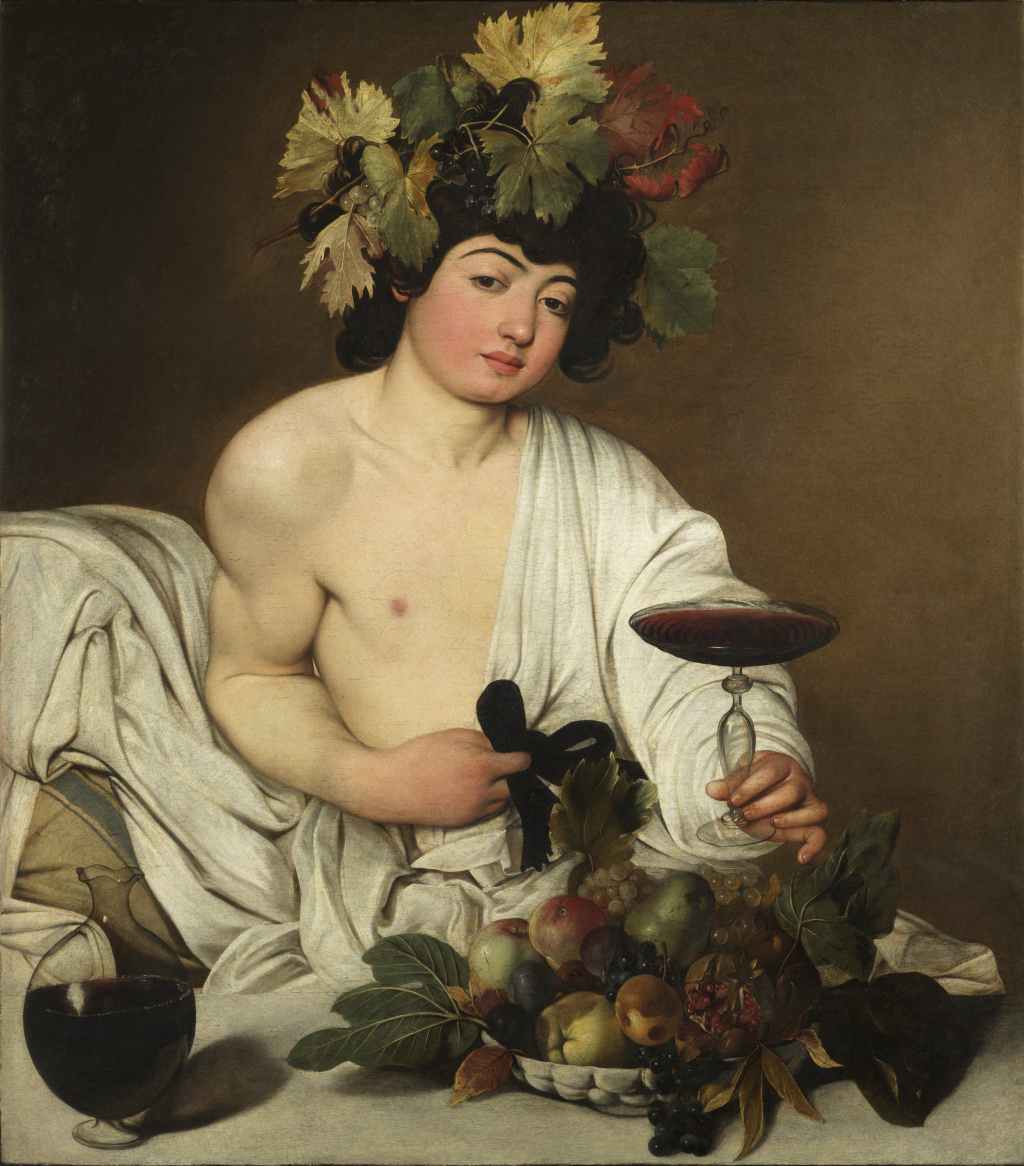
There’s a painting I often think about. It depicts young Bacchus (also known as Dionysus), the Greek god of wine-making, orchards and fruit, vegetation, fertility, festivity, spectacle, and madness, in a reclining position wearing red green vine leaves and onyx grapes like a crown made of an ancient forest. His right hand is holding on to the drawstring on his robe that reveals half of his hairless chest, his other hand is holding out a blown glass goblet brimming with red wine. There is a slab of grey stone in front of him on top of which rest a half-filled carafe of red wine and a bowl filled with fruits as varied as figs, apples, jade grapes, a burst and overripe pomegranate next to a rotting apple. Fruit, like life, rots quickly and so must also be consumed quickly.
This painting was made by the Italian painter Caravaggio, who once also murdered a man. He developed a style, known as tenebrism, combining intense use of light and shadow with equally intense physical observation. He liked working quickly, preferring live models and direct painting on canvas, rather than beginning with drawing and spent most of his life in Rome. It was on 29th May 1606 that Caravaggio murdered a man named Ranuccio Tommasoni after a brawl over a sporting bet. The murder followed a series of troubling events caused by his volatile moods. The British art historian Andrew Graham-Dixon has suggested that Caravaggio killed Tommasoni over a prostitute named Fillide Melandroni. A report written by the barber surgeon who examined Tomassoni’s dead body suggested that Tomassoni bled to death through the femoral artery in his groin, so it’s possible that Caravaggio had tried to castrate him.
He ran away from Rome, after having been served a death sentence, hiding on estates owned by Colonna while continuing to paint and completing works like his second Supper at Emmaus and a painting of a Magdalene that is now believed to be lost. By October, he was in Naples but also in Malta and Sicily. In Naples, he once again established himself as one of the most prominent Italian painters of the time before getting involved in another violent clash that led to his face being disfigured. He died in 1610 while on his way from Naples to Rome. It is believed that he died of a fever but it has been speculated that he was murdered or that he died of lead poisoning.
Caravaggio’s last known painting was The Martyrdom of Saint Ursula, painted in 1610. The painting depicts the legend of Saint Ursula, when she and her eleven thousand virgin companions fell into the hands of the Huns. The virgins were massacred one by one. Ursula alone was spared, her modesty and beauty captivating the Hun king, who offered her life in exchange for marriage. She refused. In response, the king killed her with an arrow, making her a martyr.
What does it mean to be a good person? I have searched many times for an answer in a Caravaggio painting that, each time, offers life in place of answers.

