
On the pelouse of the 12e arrondissement of Paris, there was a red tent that seemed transported directly from the circus grounds of Jaipur of my childhood. Inside, there was hot air blowing so one could immediately forget how cold it was right outside. There was hot spiced wine, hot chocolate, hot dogs, popcorn, fries, beer, and cotton candy spun right in front of your eyes, layer after layer after layer. The seats were divided by colour and category. The presenter, wearing a glittering red coat, started the show that was quickly followed by acts, sometimes marvellous, sometimes disappointing: a Spanish dancer rotating 4 red circles with four of her limbs, suspended in air, an Italian man hopping up and down stairs with one hand, then with a crutch in that hand, a Frenchwoman suspended on a bar rotating with her neck in a rope, a man shooting arrows through many rotating balloons simultaneously, a couple magically appearing in different clothes from under a blue garb, clowns and jesters peppering the performance with banality, four bikers biking inside a small globular object.
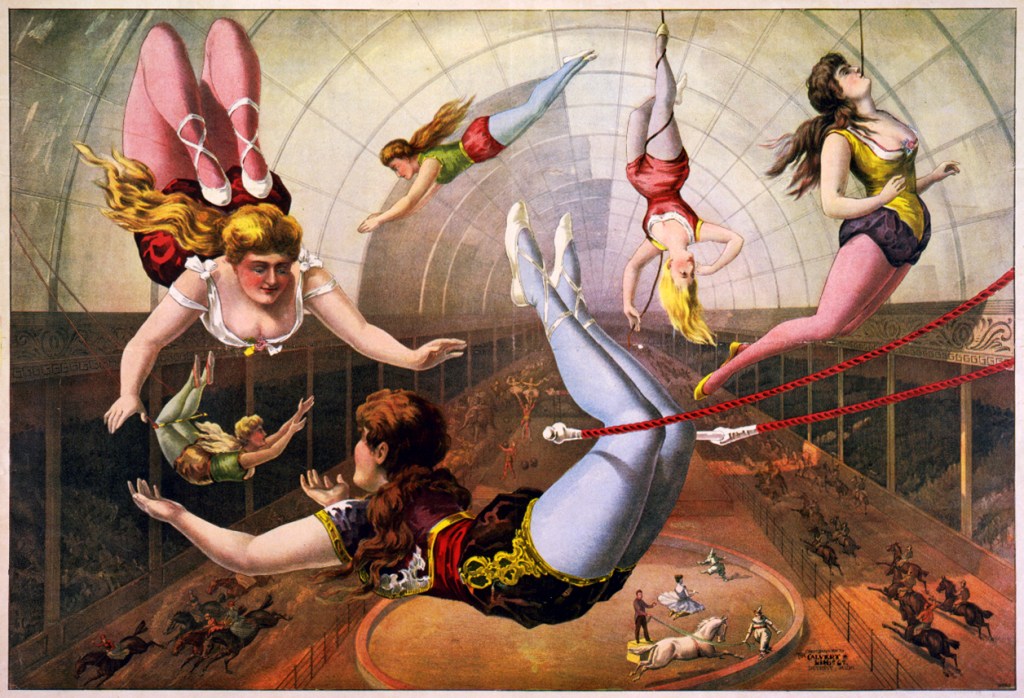
There were, somewhere in the middle of these performances, four trapeze artists. The word “trapeze” comes from French trapèze, which derives from Late Latin trapezium, itself from Greek trapézion, “little table”. That is a diminutive of trápeza, “table”, traditionally analyzed as tetra- (“four”) + péza (“foot”). The apparatus took its name from its shape: a bar suspended by two ropes forms a quadrilateral with unequal sides, like the geometric trapezium. Trapeze art developed in the mid-19th century with the French gymnast Jules Léotard generally credited with the first flying trapeze act, which he performed at the Cirque Napoléon in Paris in 1859, after practicing over cushions in his father’s swimming-pool gymnasium in Toulouse. He moved between swinging bars in mid-air. The “catcher” was added later in the century, so that a flyer released from one trapeze was caught by a partner hanging from another.
On this particular night, two of the flying trapeze artists fell. Unable to catch the swinging hands of the catcher, the artists fell directly into the net. They tried again, and fell again. There was no redemptive act that made one forget the fall. They fell repeatedly while the tent full of seated and standing people looked on, feeling a mixture of glee and pity while witnessing a fall.
That night, the trapeze artists had to walk away from the stage as the fallen people. One of many, one of millions, many of whom just happened to be seated that night having fallen yesterday, or the day before, or awaiting a fall: first or another.

